Modern businesses operate globally, working with international partners, entering new markets, and creating multilingual content. In this environment, translation plays a key role in communication, customer trust, and international growth.
Modern businesses operate globally, working with international partners, entering new markets, and creating multilingual content. In this environment, translation plays a key role in communication, customer trust, and international growth.
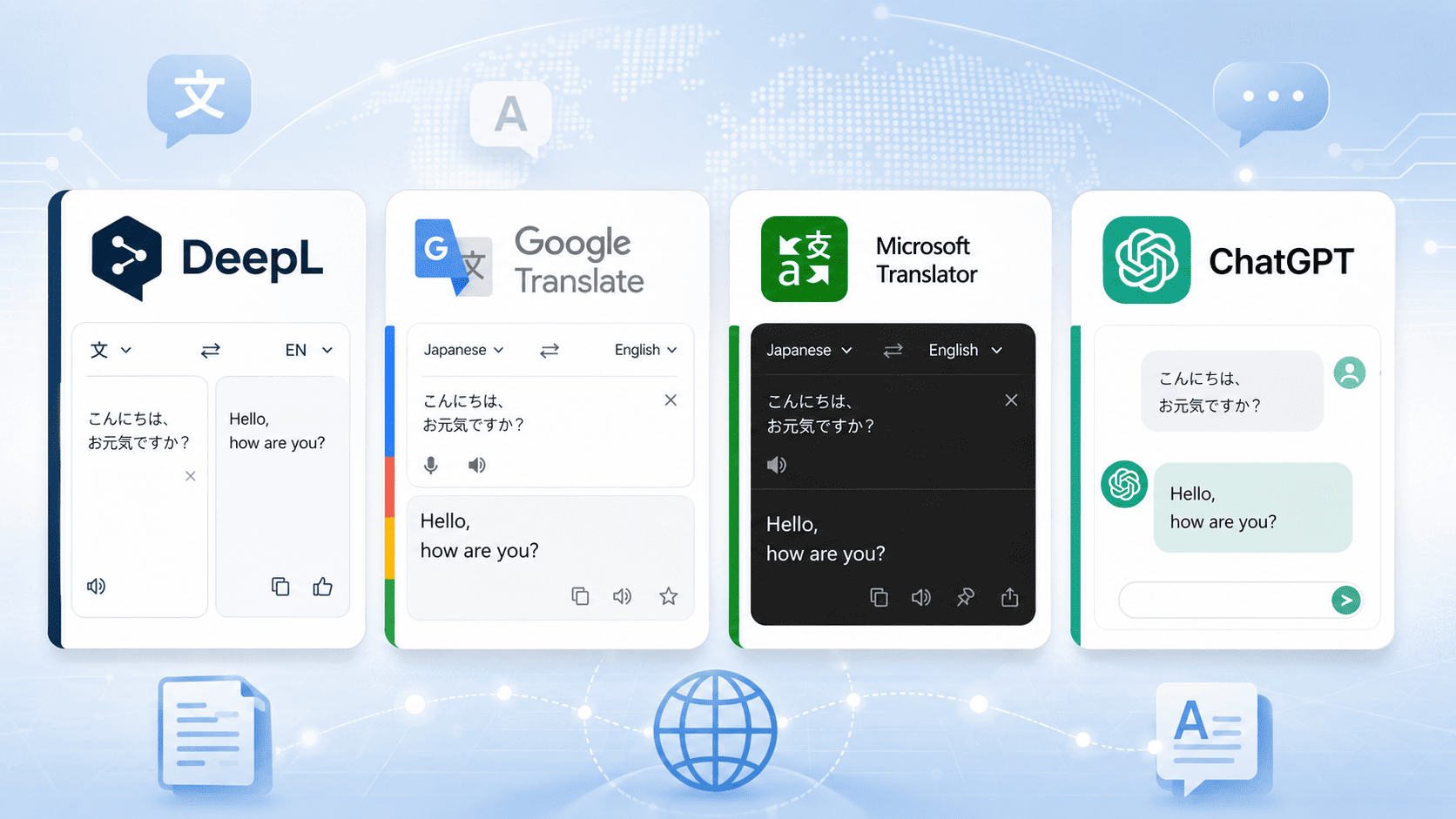
The rise of artificial intelligence, Neural Machine Translation (NMT), and Large Language Models (LLMs) has made AI translation for business faster and more accessible. Companies can now use tools such as DeepL, Google Translate, Microsoft Translator, and ChatGPT to process multilingual content.
However, AI cannot always replace human expertise. Professional translators remain essential for materials that require accuracy, cultural adaptation, and industry knowledge.
This article explores AI vs human translation, compares the strengths and limitations of both approaches, and explains why a hybrid workflow often provides the best balance of speed, quality, and cost.
What Is AI Translation for Business?
AI translation for business is an automated process where artificial intelligence analyzes text, understands context, and generates translations. Modern AI-powered translation is based on technologies such as Neural Machine Translation (NMT) and Large Language Models (LLMs).

NMT analyzes sentences in context to improve accuracy, while LLMs can adapt style, explain terminology, and support localization.
Popular AI translation tools include:
- DeepL – for document translation and business communication;
- Google Translate – for quick multilingual translation;
- Microsoft Translator – for corporate workflows;
- ChatGPT – for translation, editing, and localization.
The main advantage of machine translation for business is speed, but companies should consider machine translation limitations and use AI as a supporting tool.
What Is Human Translation?
Human translation for business is a professional process that focuses on meaning, context, and communication goals rather than word-for-word translation.
Professional translators consider:
- industry expertise;
- target audience;
- cultural context;
- company tone of voice.
Human specialists provide editing, proofreading, terminology control, and cultural adaptation, ensuring accurate and natural communication.
AI vs Human Translation: Key Differences
Choosing between AI and human translation depends on business goals, content type, deadlines, and quality requirements. AI vs human translation is not about choosing one universal winner – both approaches serve different purposes.
| Factor | AI Language Translation | Human Translation |
| Speed | Very fast processing of large volumes | Depends on complexity and expertise |
| Cost | Lower, usually subscription-based | Higher due to professional skills |
| Accuracy | Suitable for standard content | Higher accuracy for complex materials |
| Creativity | Limited by algorithms | Creates natural wording |
| Cultural adaptation | Basic adaptation | Full localization |
| Scalability | Handles large volumes easily | Depends on specialists |
| Tone of voice | Limited brand adaptation | Maintains brand consistency |
| Technical terminology | May make mistakes | Ensures industry accuracy |
The comparison of human translation vs machine translation shows that AI is best for speed and scalability, while human translation provides accuracy, localization, and quality control.
Advantages of AI Translation
Businesses use AI translation for business to automate workflows, reduce costs, and manage multilingual content efficiently.
Fast turnaround
AI tools generate translations within seconds, helping companies process documents and communicate faster.
Lower costs
Business translation services are often more affordable through subscription or API-based models.
Scalability
AI systems can handle large volumes of documents, product descriptions, and internal content.
Ideal for internal documentation
AI translation is suitable for:
- internal documents;
- business communication;
- technical instructions;
- knowledge bases;
- draft materials.
24/7 availability
AI tools are available anytime, supporting global teams across different time zones.
Advantages of Human Translation
Professional translation services remain essential when accuracy, cultural understanding, and brand reputation are important.
Cultural understanding
Professional translators adapt messages to local markets and cultural expectations.
Brand voice consistency
Human experts preserve brand identity, tone of voice, and communication style.
Better context interpretation
Translators understand intent, ambiguity, and complex meanings that AI may miss.
Legal accuracy
Professional review helps ensure accuracy in contracts, official documents, and regulatory materials.
Marketing localization
Human translators adapt campaigns, slogans, and product messages for specific audiences.
When Businesses Should Choose AI Translation for Business
Machine translation for business is a practical solution when companies need speed, scalability, and quick access to multilingual content.
AI tools are commonly used for:
Internal communication
AI helps translate emails, meeting notes, team communication, and operational updates.
Product descriptions
AI can create initial product descriptions for large catalogs, while important content should be reviewed before publication.
Knowledge bases
AI supports multilingual FAQs, knowledge bases, and customer support materials.
Technical manuals and large document volumes
Machine translation for business helps process standard documentation and large content volumes faster. However, specialized terminology requires review due to machine translation limitations.
When Human Translation Is the Better Choice
Although AI continues to improve, human translation for business remains essential when accuracy, compliance, and reputation are critical.

Professional translation is recommended for:
Marketing campaigns
Require creativity, emotional impact, and cultural adaptation.
Website localization
Helps create natural content and improve customer trust.
Contracts and legal documents
Require precise terminology and expert review to reduce risks.
Medical content and financial reports
Need specialized knowledge and maximum accuracy.
PR materials and executive communications
Require consistent brand voice and careful adaptation.
Hybrid Translation: Combining AI Speed with Human Expertise
Many companies combine AI technology with professional review through Human-in-the-Loop translation or Machine Translation Post-Editing (MTPE).
The workflow includes:
- AI creates the first translation draft.
- Human editors review accuracy, terminology, and context.
- The content is refined through post-editing and style improvements.
- The final version is localized if needed.
This approach combines AI speed with human expertise, delivering faster results while maintaining higher quality.
Cost Comparison: AI Translation vs Human Translation
Translation costs depend on content type, language combination, volume, deadlines, and quality requirements.
| Translation format | Estimated cost | Quality |
| AI translation tools | Low to medium (subscription/API) | Suitable for standard content and drafts |
| Professional translators | Medium to high (per word/hour/project) | High with industry expertise |
| Hybrid translation | Medium | High with professional post-editing |
ROI considerations
Businesses should evaluate translation by value, not only price. Low-quality translation may cause technical errors, legal risks, and customer trust issues.
Quality translation is an investment in brand reputation and international growth. Learn more in The Total Economic Impact™ of DeepL study.
Common Mistakes Businesses Make
Companies may reduce translation quality by choosing the wrong approach.
Common mistakes include:
- using AI for legal contracts without human review;
- ignoring localization;
- choosing the cheapest option without considering quality;
- not proofreading AI-generated content;
- overlooking data privacy and confidentiality;
- using inconsistent terminology.
A successful translation strategy requires balancing cost, quality, security, and business goals.
How to Choose the Right Translation Solution
Before choosing a translation method, businesses should consider:
✓ Budget
✓ Deadline
✓ Industry requirements
✓ Target audience
✓ Required quality level
✓ Confidentiality needs
✓ Brand reputation
✓ Regulatory requirements
Decision framework:
- Choose AI translation for speed, scalability, and internal content.
- Choose professional translation for accuracy, localization, and reputation.
- Choose a hybrid approach for a balance of efficiency and quality.
For legal, medical, financial, and brand-related materials, consider professional translation services or AI-assisted workflows with expert review.
Conclusion
Artificial intelligence has transformed the translation industry. AI translation for business helps companies automate workflows, process large volumes of content, and reduce costs.
Neither AI nor human translation is universally better. AI is ideal for speed and scalability, while human translation provides quality, accuracy, and localization.
For many businesses, a hybrid workflow offers the best balance of cost, speed, and reliability.
Evaluate your business needs, content type, and quality requirements to choose the translation approach that best aligns with your goals and supports international growth.